

You have shared the proposal story, sent around the ring photos, and started telling everyone you are engaged. Then you sit down to write a caption and stop: is it “my fiancé” or “my fiancée”? This VedVed guide breaks down “fiancé” vs. “fiancée” so you can pick the right spelling.
Fiancé vs. Fiancée: Meaning and Use After Getting Engaged

Traditionally, “fiancé” means an engaged man, and “fiancée” means an engaged woman. The word describes your partner, not you, and it does not matter who proposed. Both terms apply from the moment you agree to marry until the wedding.
What Does Fiancé Mean?
A fiancé is a man who has agreed to marry someone. If your partner is a man, use the masculine form.
You might say, “This is my fiancé, Daniel,” when introducing him to friends. Or you could tell a wedding vendor, “My fiancé and I are looking for a venue for next fall.”
You can start using the word as soon as you have said yes. You do not need a ring, a date, or a booked venue.
What Does Fiancée Mean?
A fiancée is a woman who has agreed to marry someone. The extra “e” comes from the feminine form of the French word.
For example, “Meet my fiancée, Emily,” or “My fiancée and I are sending out our save-the-dates this week.”
The spelling follows Emily, not the person she is marrying. Whether she is engaged to a man, a woman, or a nonbinary partner, she is still a fiancée.
What Is the Difference Between Fiancé and Fiancée?
The difference between “fiancé” and “fiancée” is just one letter, and it is easiest to see side by side:
| Word | Traditional meaning | Example |
| Fiancé | A man engaged to be married | “Daniel is my fiancé.” |
| Fiancée | A woman engaged to be married | “Emily is my fiancée.” |
Who proposed does not affect which word you use. If Emily proposes to Daniel, he is still her fiancé, and she is still his fiancée. The same goes for who is wearing the ring.
Here is a simple memory aid: male and fiancé each have one “e,” while female and fiancée each have two.
When you are writing about another couple, use the terms they use for themselves. If you are unsure, using their names or the term “engaged partner” is perfectly fine.
Fiancé vs. Fiancée Pronunciation: Do They Sound the Same?
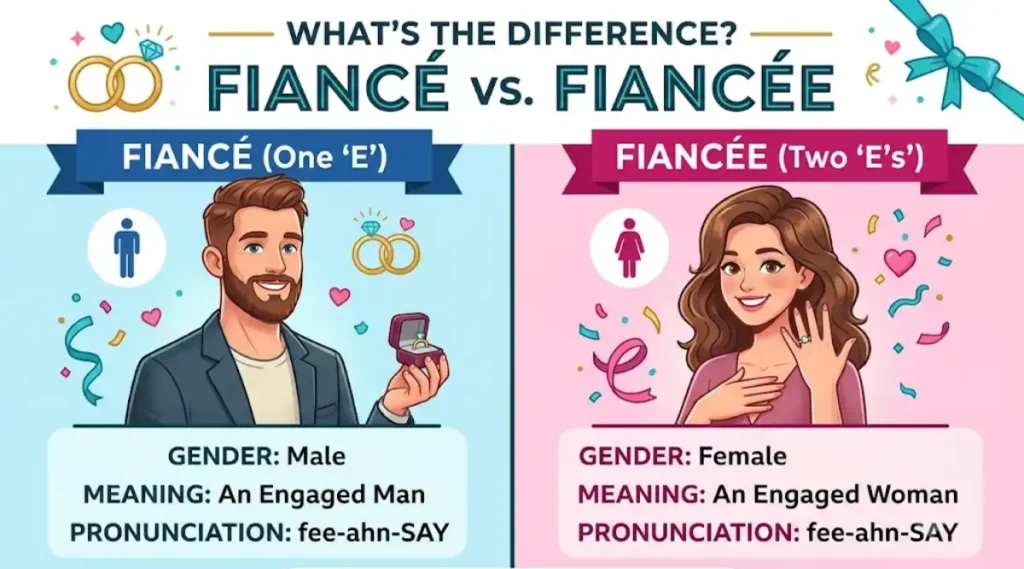
They do. Both words are usually pronounced “fee-ahn-SAY,” and the extra “e” in fiancée does not add a syllable. So when you introduce your partner out loud, you do not have to think about it. The difference only shows up on the page.
Traditionally, both words carry an acute accent over the first “e”: fiancé and fiancée. You will also see them written as “fiance” and “fiancee” without accents, especially in texts and social posts. Dropping the accent does not change the meaning or the sound. For an engagement announcement or wedding website, though, it is worth copying the accented spelling.
Where Do the Words Fiancé and Fiancée Come From?
Both words came into English from French, from the verb “fiancer,” which means “to promise in marriage.” French marks gender in its word forms, which is why the endings differ. English borrowed both spellings, even though most English relationship words do not change this way. You do not need to know French grammar to use them correctly. Just remember that the extra “e” marks the feminine.
Alternatives to Fiancé and Fiancée
You might love saying “fiancé” or “fiancée,” or you might feel that “partner” sounds more like you. Either is fine. Here are some other options:
- Partner: familiar and easy in everyday conversation
- Future spouse: makes it clear you are planning to marry
- Spouse-to-be: a good fit for an announcement or introduction
- Betrothed: an old-fashioned term that some couples enjoy
- Intended: traditional wording for the person you plan to marry
Sometimes plain language works best: “My partner and I are getting married next spring” shares the news clearly. If you or your partner prefer a gender-neutral term, pick one together. And when someone tells you how they would like to be introduced, go with their wording.
Introducing Your Partner After the Engagement
“Fiancé” is for an engaged man, and “fiancée” is for an engaged woman. Both sound the same when you say them aloud. Keep this VedVed guide handy when you write your engagement caption or wedding website. Whichever term you choose, use the one that feels right when you share the news.
You can check this blog as well: “Miss vs. Ms. vs. Mrs.: What’s the Difference and When to Use Each?“
Frequently Asked Questions About the Difference Between Fiancé and Fiancée
Q1. Is “fiancée” correct for both men and women?
A1. Traditionally, “fiancé” refers to a man and “fiancée” to a woman. Follow the term your partner prefers.
Q2. Do “fiancé” and “fiancée” sound different?
A2. No, both sound the same. The extra “e” only changes the spelling.
Q3. Why does the fiancé have an accent mark?
A3. It keeps the accent from the French word, although “fiance” is also used in English.